


MakeBeth is a playful twist on Macbeth. What drew you to reimagining this particular story, and why now?
Its something I’ve really wanted to do for a while, not necessarily with Macbeth, but taking a heavy, classic text dripping with adult themes treated with reverence by so many and make it into something playful and interactive and fun, we looked at doing a few other titles to start with, but pretty early on Hannah Khalil (the writer) suggested Macbeth it very quickly became the only option.Macbeth’s one of Shakespeare’s most intense and recognisable stories – it’s packed with ambition, power, and consequence, but also has this slightly surreal, almost chaotic energy that lends itself well to playfulness. Reimagining it as MakeBeth felt like an opportunity to open that world up to young people, make songs about characters loosing their heads, get to play as ghosts, really find a way to make it accessible and memorable. Right now, there’s also something really resonant about questioning power and leadership, so it felt like the right moment to explore those ideas in a way that’s imaginative, funny, and a bit anarchic.
Cardboard is central to your company’s style. How does it shape the storytelling and audience experience in MakeBeth?
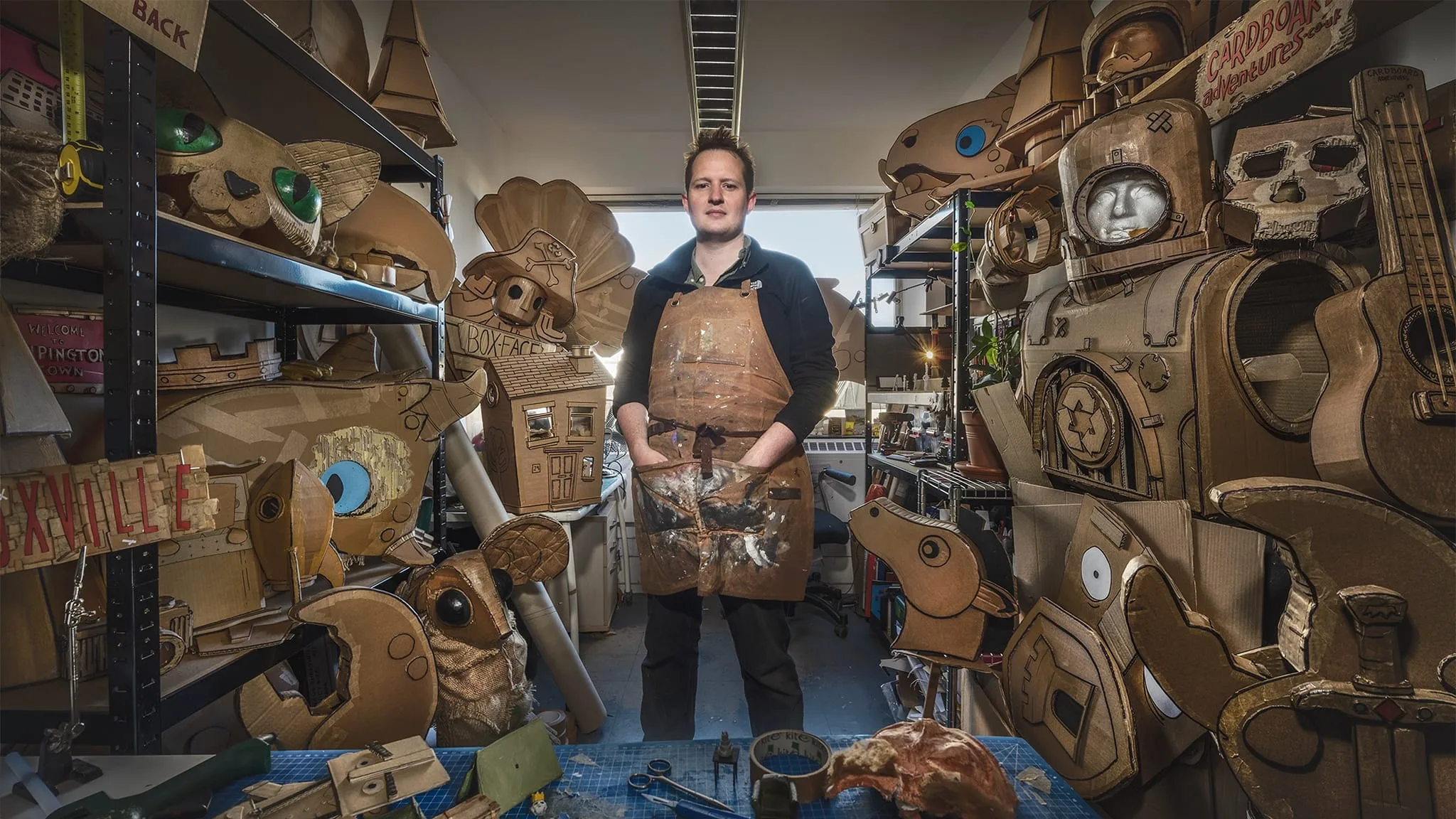
So I always say that for me, cardboard is about two things; its about play (that old adage that you got a toy and all you want to do is play with the box!) and its about mistakes (it’s the perfect materials to TRY with. If it fails its no big thing, you can always get another box!) – it’s not just an aesthetic choice, it’s central to our philosophy. It invites transformation. A single piece can become a castle, a crown or a battlefield within seconds, and that constant reinvention encourages the audience to use their imagination alongside us.
In MakeBeth, cardboard helps keep the world playful and fluid and is really linked to the magical language in the show, which is really important when you’re tackling a story that’s quite dark at its core. It also creates a sense of shared creativity – this is a craft-a-long show, the audience is helping to actually build the show, its not something fixed and polished, its a thing we make together. I always say that I want people to leave our shows thinking “I could do that” and with cardboard they can!
How do you balance humour and the darker themes of ambition and power that are so central to Macbeth?
For us, humour isn’t about undercutting the darker themes, it’s a way of making them more accessible. By inviting the audience to laugh, we also invite them to engage more deeply and ultimately to access the story. The comedy creates space, so when the darker moments land, they still have weight. It’s a careful balance – we never want to lose the stakes of the story – but we’re interested in contrast. The silliness can actually sharpen the tragedy, but we never dwell on it too much in this version, the focus is on the story of Macbeth, not on the tragedy of it, of course its present, and we certainly embrace it at times, but its not the focus. Hannah (Khalil) has really got that fine line perfectly balanced in the text!
What has been the most surprising or challenging part of developing MakeBeth?
We’ll I’m not sure I’d say surprising or even challenging, but unlike BOXVILLE (our earlier show) we really wanted live music to be a big part of MakeBeth, that just like the props and bits the audience make the actors are physically making the sounds on the stage as well, it takes me a little out of my comfort zone as I’m about the least musical person you can imagine, but that’s why you bring in people like Harry Miller, Angus Tikka and Elizabeth Ellen (our performers) each and everyone of them is a musical genius. You’ll leave this show with a chunk of cardboard makes, an understanding of Macbeth and a tune in your heart!
What do you hope younger audiences take away from MakeBeth after seeing the show?
I mean, this is a craft-a-long show, so during the show you’ll get your tools and you’ll get a box and you’re going to make things to progress the story and anything you make, you take home with you, so you’ll certainly take away a few things, but we’ve said a few times in rehearsals that this is aimed at being our younger audiences members first experience of Shakespeare, so we really want it to feel welcoming, exciting, and not intimidating. If they come away thinking, “That was fun” and even better just have an opinion about Macbeth‘s behaviour, then that’s a huge win. More than anything, we hope it opens the door to Shakespeare rather than closing it – showing that these stories can be playful, accessible and relevant. If it sparks a bit of curiosity or confidence to explore more, then we’ve done what we set out to do.